One Hull, Two Missions: Arctic Patrol Ships Take On Science
An icebreaker used to break ice. A patrol ship used to patrol. For decades, that was the whole job description. For the government ships being built now, it’s only the start.
Nowhere is the shift more striking than in the Arctic. Ships built to patrol the high north for sovereignty are being equipped to collect scientific data as well, including the water-column data that seafloor mapping depends on. A transit that used to be "wasted" time from a data-collection standpoint can become a science mission. The ship doesn't stop being a sovereignty asset - it just stops being only that.
At first glance, it seems like a strange pairing. Presence and data don’t naturally belong on the same hull. Fusing them isn't consolidation, it's stacking two unrelated missions onto the same very expensive asset, simply because idle time is no longer acceptable.
It’s a Global Pattern
Norway got there early. The KV Svalbard, commissioned in 2002, was Norway's first icebreaking coast guard vessel, but in 2019 it became the first Norwegian ship to reach the North Pole on a scientific mission. One hull, two unrelated jobs. Canada later used the Svalbard’s design as the template for its own Harry DeWolf-class Arctic and Offshore Patrol Ships (AOPS). Eight hulls were built: six for the Royal Canadian Navy and two for the Canadian Coast Guard. The two Coast Guard variants, vessels #7 and #8, are fitted out for science missions alongside patrol work. Canada is also building two new polar icebreakers for the Coast Guard, which will carry advanced, ice-protected multibeam echosounders for seabed mapping and a wide range of scientific sensors.
Canada’s planned Multi-Purpose Icebreaker (MPI) program - up to sixteen hulls - is designed to cover icebreaking, flood response, search and rescue, security, and navigation all in one class. The US is running a similar playbook with its own Arctic Security Cutter (ASC) program, whose announcement names national defence, maritime sovereignty, scientific research and search and rescue as core missions for a single hull.
It's not confined to the Arctic: Australia's RSV Nuyina doubles as a science platform and supply ship, the UK converted an oil-industry vessel (RFA Proteus) into a seabed-surveillance ship, and Russia's Ivan Papanin-class combines patrol, icebreaking, and science in one hull.
Separate parties, different problems, the same solution.
The Business Case
The economics are straightforward: as fleet sizes are shrinking, each remaining hull is expected to do more. This isn't just designers' preference - naval buyers themselves are asking for modularity as a requirement, not a feature.
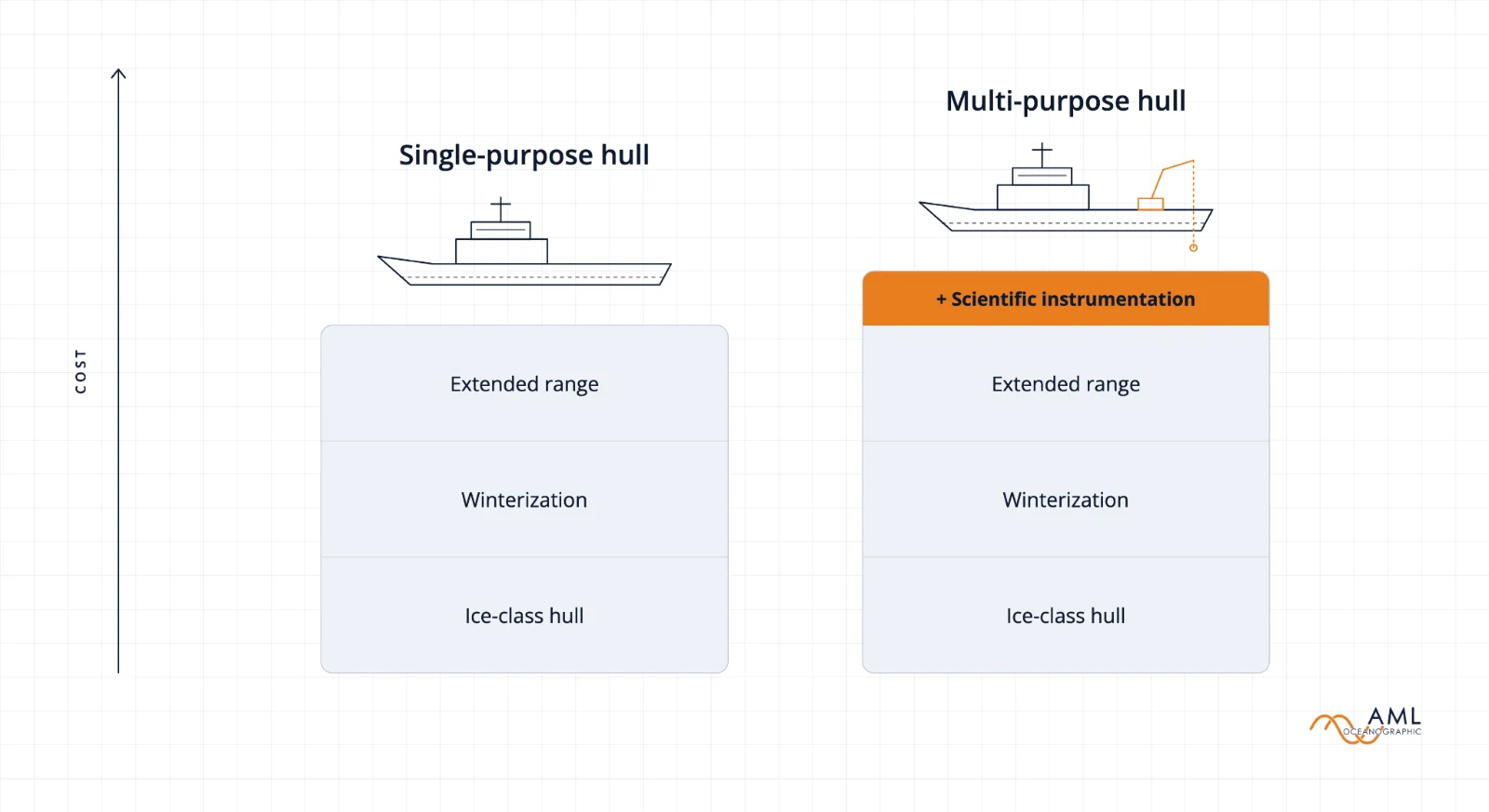
The same pressure is building on the civilian science side. Running a dedicated research vessel can cost tens of thousands of dollars a day, pushing oceanographers toward vessels of opportunity - ships already at sea for other purposes. Arctic-capable ships, for example, are extremely expensive; they are winterized, equipped with ice-class hulls and extended range. Once a government has invested in that, the cost of equipping the hull to collect real science data is comparatively small.
The Hardware Behind the Idea
Deciding a ship should do more is one thing; building one that actually can is another - and that comes down to two separate pieces of engineering solving two different problems.
The first is modularity at the hull level. Systems like Kongsberg's Mission Bay Handling System (MBHS) let a vessel swap standardised containers, launch small craft, and reconfigure its mission bay without a structural refit. This is the mechanism that answers "how does one hull go from doing Job A to doing Job B." It's the reason a multi-purpose ship isn't just a big empty deck and good intentions.
But systems like this don't collect data - they make room for the equipment that does.
That's the second piece, and it's where AML fits in. The MVP300 is a self-contained profiling system that samples the water column to depths of 300 metres at vessel speeds of up to 12 knots - even deeper at slower speeds - collecting near-vertical profiles of sound velocity, conductivity, temperature, and depth (CTD) while underway. That same water-column data - sound velocity in particular - is also what hydrographic surveys depend on: it's the correction factor that turns raw sonar readings into an accurate map of the seafloor below. The MVP300 is the instrument that turns a transit into a survey.
Delivered, Ordered, and Spec’d In
We've been building in this direction for a while, on more fronts than one.
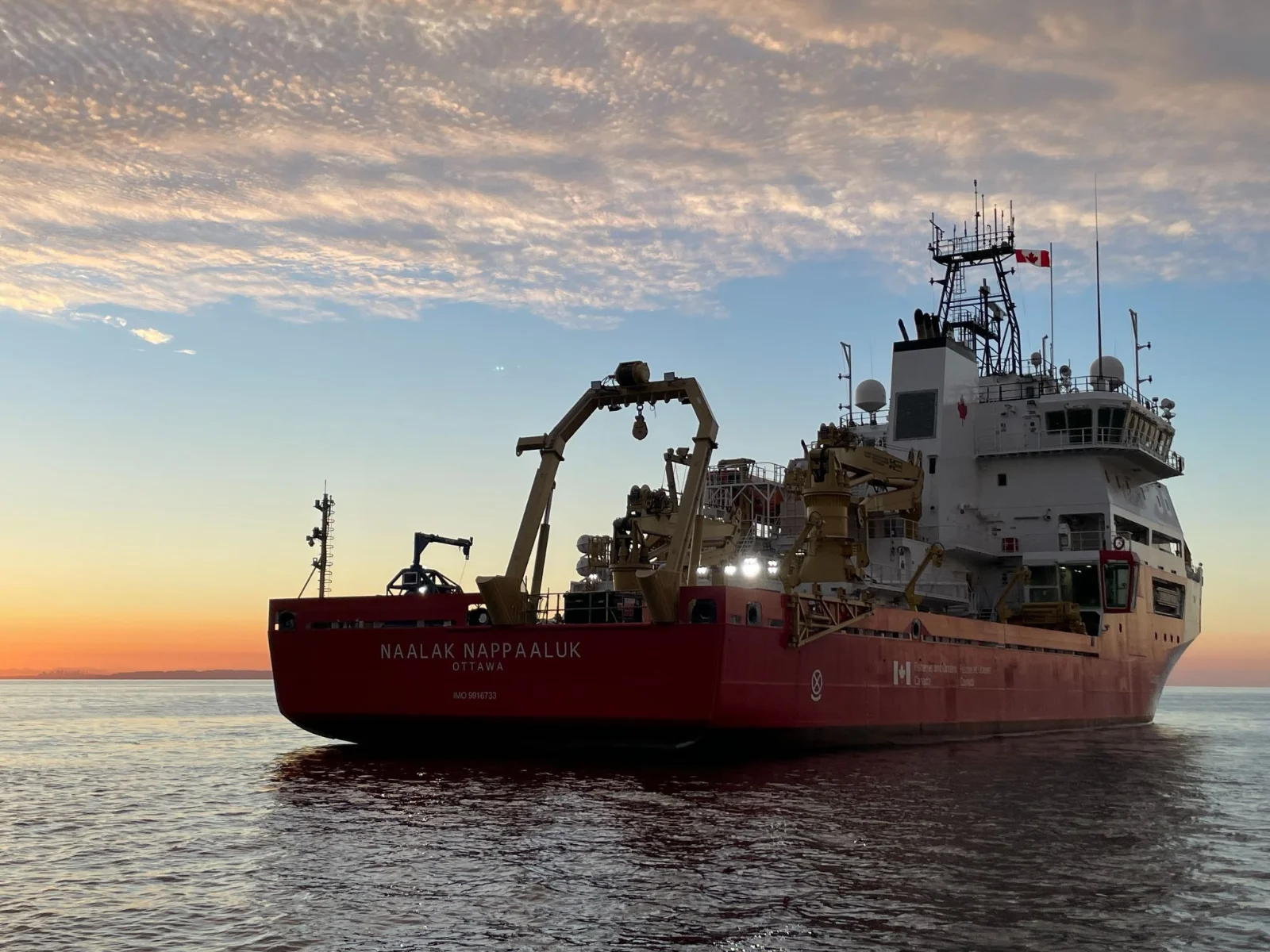
In Canada, an MVP300 is delivered and operating aboard the CCGS Naalak Nappaaluk, the Coast Guard's new Offshore Oceanographic Science Vessel (OOSV). The same system is heading into the Arctic patrol fleet itself: AML is delivering MVP300 systems to Lockheed Martin for AOPS #7 and #8 - the CCGS Donjek Glacier and CCGS Sermilik Glacier. There, they will support the scientific research capability built into these ships - collecting CTD and a range of other oceanographic parameters as they operate.
As Canada's planned Multi-Purpose Icebreaker fleet takes shape, the first MVP300 unit has already been ordered. That same design lineage is crossing the border: MVP300 is spec’d into the US Coast Guard's Arctic Security Cutter program - eleven hulls planned in total, with construction already underway in the US and Finland.
Canada's fleet renewal doesn't stop there. In August 2026, the federal government committed $11.3 billion to build six new Program Icebreakers (PIB) for the Canadian Coast Guard - vessels the government describes as built for versatility, capable of carrying out a wide range of missions. It’s early days, but this is the kind of multi-mission fleet MVP300 is suited to.
What's Actually at Stake
Most of what we know about the ocean has been collected in patches - wherever a dedicated research ship happened to go, whenever budgets allowed. The Arctic gap is huge: perennial ice cover means only a small number of specialized ships could ever get there to look, so entire stretches of it, including most of its seafloor, have simply never been surveyed to modern standards. Seabed 2030 - the international effort to chart the entire ocean floor by the end of the decade - is the clearest proof that the gap is still open, and the Arctic is one of the hardest places to close it. That's more than a scientific problem. You can't safely navigate water you've never actually measured.
That's exactly what is starting to change. Closing that gap is less likely to come from a new fleet of dedicated research ships than from the ships already up there, once they’re equipped to do the job.
Patrol ships and icebreakers aren’t getting second jobs because governments stopped needing them to patrol, break ice, or guard a coastline. They’re getting them because doing only one job on a hull that expensive is getting harder to justify.
That's where AML comes in. The hull can be built for two jobs, but only the right instrument turns idle transit time into real data. As this next generation of Arctic ships takes shape, we’re already on board.
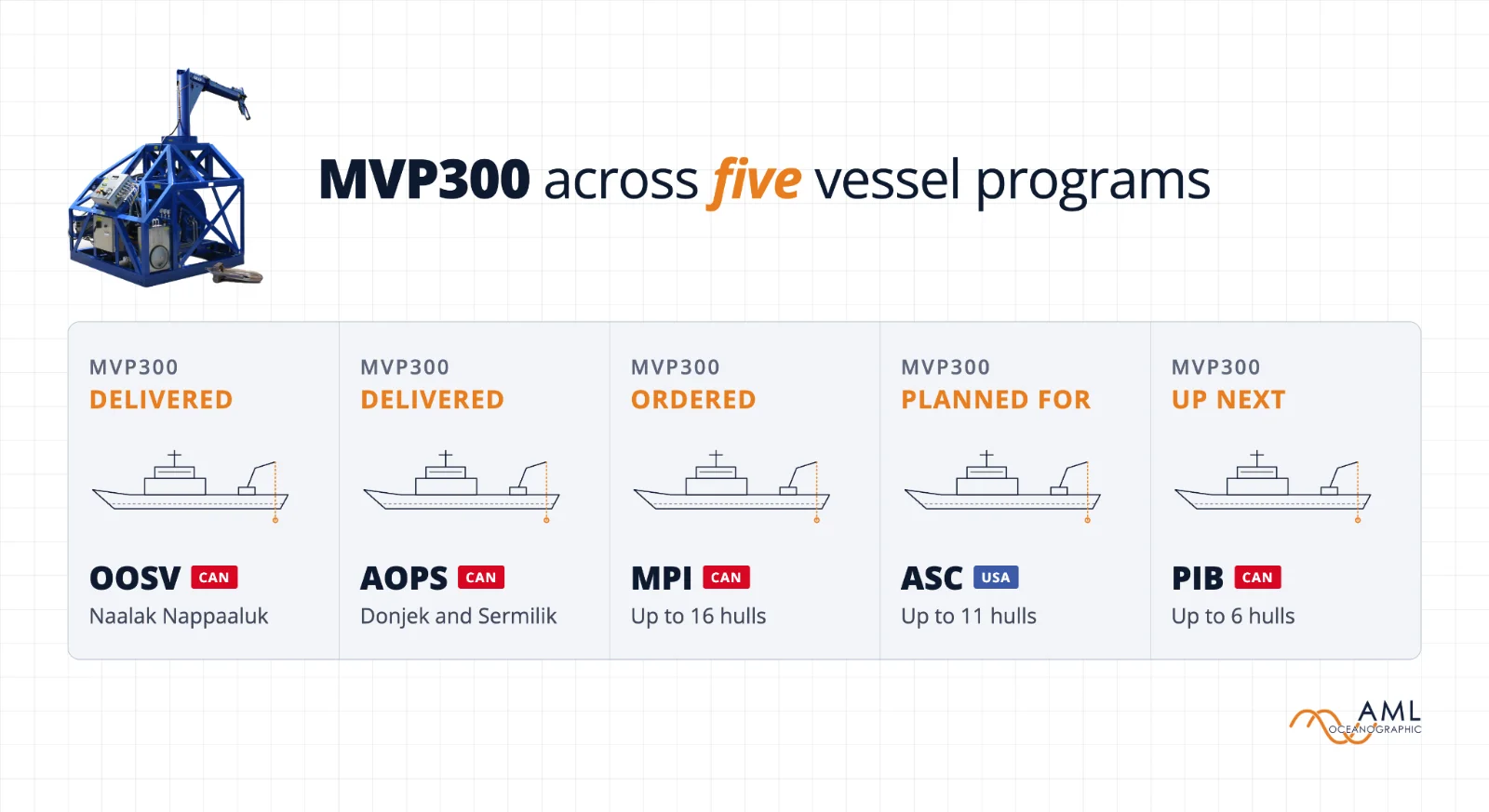
Delivered on Canada's newest science vessel. Delivered on the Arctic patrol fleet itself. Ordered for the icebreakers now under construction. Planned for the cutters that will carry the same design across the border. And next up: the six icebreakers announced in August.


